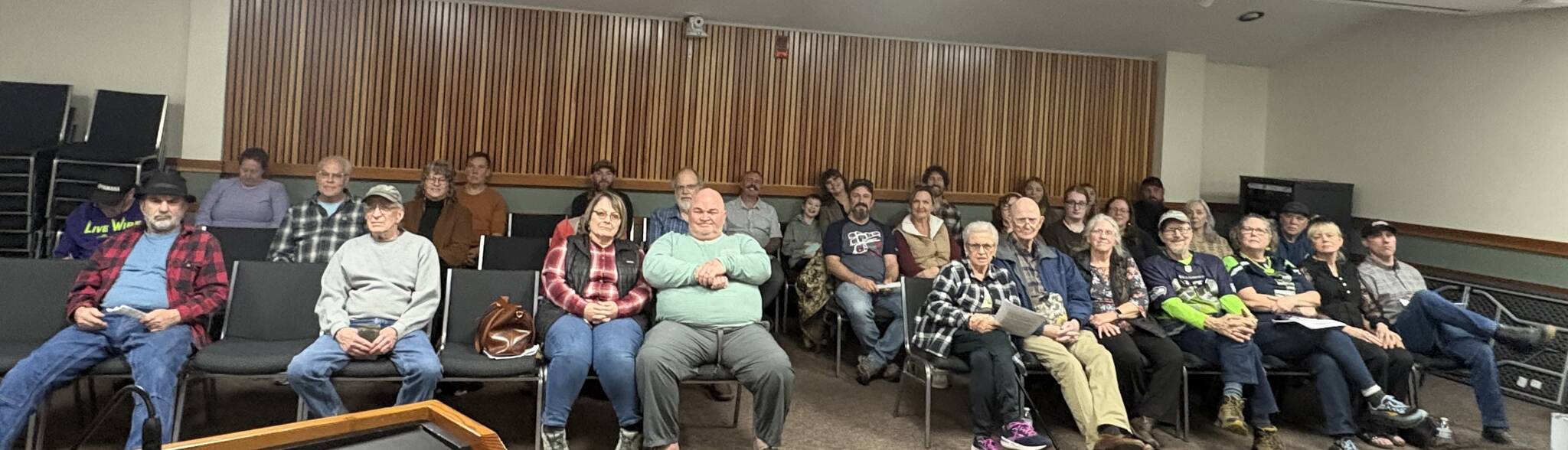
A good-sized crowd filled the Clallam County Courthouse on Thursday, Feb. 5, for a public hearing on the proposed Luminary Resort development at Grouse Glen, with the vast majority of speakers voicing concerns or outright opposition to the project.
The proposal calls for 32 mirrored, one-bedroom cabins to be developed in phases on a 21-acre parcel near the Grouse Glen neighborhood in the Sol Duc Valley. The hearing was overseen by Clallam County Hearing Examiner Stephanie Marshall, with all public commenters sworn in before speaking.
Enrique Valenzuela, speaking on behalf of Clallam County, outlined several conditions and changes that county staff said would be required for the project to move forward. These included reducing the number of cabins, developing a comprehensive fire plan, addressing trespassing concerns, limiting use of the community center to guests only, implementing one-cabin-per-acre, a habitat plan, and imposing seasonal limitations. Valenzuela also acknowledged the county had received a number of written comments on the proposal.
Luanne Hinkle, agent of record for Luminary Resorts at Sol Duc, told the room the project would be respectful of the community and designed as a low-impact development. She said the resort would address community concerns, including potentially creating a bus shelter for neighborhood children. Hinkle added that the Quileute Tribe had raised no objections and that no critical wildlife concerns had been identified.
However, many residents disputed those claims.
Sheila Bernard, the first neighboring property owner to speak, said she was shocked she had not been notified about the project. “I moved here for solitude,” Bernard said, adding that she strongly disagreed with statements that wildlife would not be affected. She said elk regularly pass through her yard, a point echoed by several other residents who said elk “go where they want to go.”
Water availability was another major concern raised throughout the hearing, with residents noting that some wells already run dry during the summer months.
Arian Goodson described the proposal as fundamentally incompatible with the rural character of the area. “We live with hardship so we don’t have to live with this type of development,” Goodson said. He argued the project should instead be located within an urban growth area and claimed the county’s planning documents contained errors that appeared to be generated by artificial intelligence. He also criticized the use of prefabricated mirrored cabins.
“Nobody here today is for this,” Goodson added. “We do want growth, but this isn’t it. This is outsiders exploiting our tourism.”
The youngest speaker, Blake McClure, said he was worried about how the project would affect his future. He said increased tourist traffic would make it unsafe for him to ride his dirt bike and bicycle on the rural roads.
Don Lawley, who said his family was the second to move into Grouse Glen decades ago, said he never imagined a development of this scale. “Rayonier was our neighbor. It is a private road,” Lawley said.
Brandon Miller urged the hearing examiner to deny the project, saying it conflicted with growth management principles.
Heather Cantua, a Bear Creek area resident of five years, said she was drawn to the area because people are “part of the forest.” She criticized the project for relying on prefabricated structures from outside the country rather than using local materials and contractors. Cantua also raised concerns about emergency access, noting that severe weather can cut off the West End in both directions.
“Having just one caretaker is absurd,” she said. “These cabins will be piles of junk in a few years. There is no need to import them.” Cantua urged the county to deny the proposal in its entirety, saying it showed “a lack of respect and lack of caring.”
Felicia Larson said the community was “intentionally rural” and the project was not appropriate.
Kylie Jo and Steve Nelson both shared concerns for highway safety and no turn lanes, as well as EMS challenges.
Longtime Bear Creek resident Sherry Baysinger, who has lived in the area for 53 years, emphasized that fire protection is provided by a volunteer fire department and recalled a home that burned to the ground several years ago due to response delays.
“Elk love landscaping and bears love garbage,” Baysinger said, also noting frustration that existing local businesses have faced strict county scrutiny over water and septic issues. “I will be really disappointed if this is approved.”
Forks City Council member Corey Pearson also spoke in opposition and submitted a written statement. “Approving this project in its current form would set a concerning precedent and weaken the County’s ability to enforce its own planning and environmental standards,” Pearson wrote. “For these reasons, I respectfully request that the Grouse Glen / Luminary Resort development be denied.”
Additional concerns were raised about public notice. The Conditional Use Permit was filed on Nov. 21, 2025. Residents said only four adjacent landowners were notified by mail, while the rest of the Grouse Glen neighborhood and Sol Duc Valley residents were not. Notice was published in the Peninsula Daily News, but not in the Forks Forum.
It was also noted by Cantua that project owner “Richard” held a meeting in Houston about the development, with no presentations conducted locally in the Sol Duc Valley. Several residents said they learned about the project through social media.
What’s next
Following the public comment portion of the hearing, county staff indicated they intend to impose additional conditions on the project, including prohibiting the use of mirrored cabins and limiting the resort’s operation to the summer season only.
Luanne Hinkle, agent of record for Luminary Resorts, requested that the additional conditions be provided in writing. County staff agreed and said the conditions would be issued by Wednesday, Feb. 11.
Hinkle will then have two weeks to respond to the new conditions, with a written response due on Feb. 25. County officials said the hearing examiner will consider that response, along with the full public record, before issuing a final decision on the proposed development.