By Olivia Anderson
Many of us remember childhood moments spent picking bright, sun-shaped flowers, gifts for loved ones or ingredients for imaginative games. For me, those small bouquets were a cherished part of girlhood, gathered without knowing their names or impact.
We used them for crowns, currency, and play, unknowingly helping spread their seeds; some harmless, others invasive.
You might have similar memories, but would you guess that some of those irresistible blooms are now overtaking meadows and crowding out native wildflowers like yarrow (Achillea millefolium), Douglas aster (Symphyotrichum subspicatum), and pearly everlasting (Anaphalis margaritacea)?
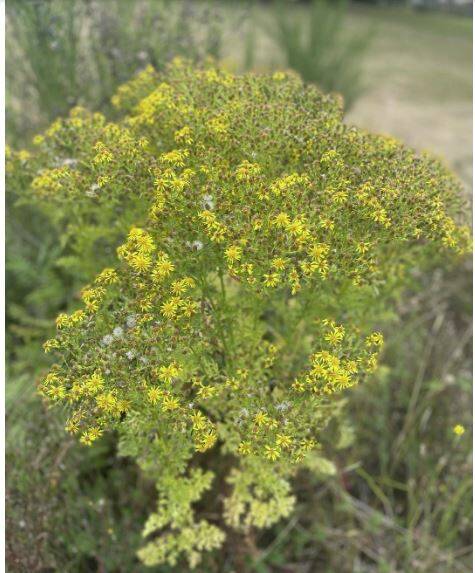
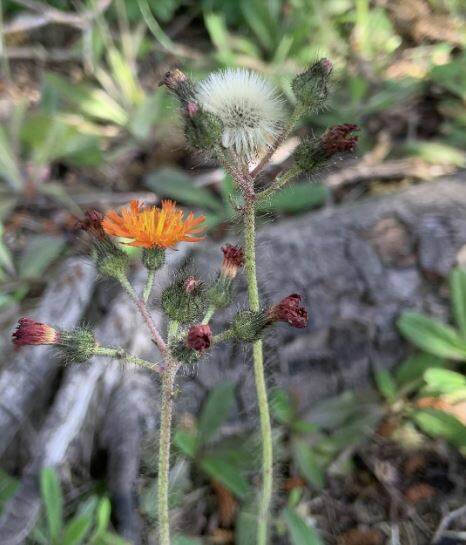
We would like to inform you about two non-native flowers that might be causing you a bit of a nuisance. Tansy ragwort (Jacobaea vulgaris) and orange hawkweed (Hieracium aurantiacum). These plants may not deserve a round of applause, but they do deserve a spotlight on them and here is why.
Tansy ragwort is a toxic noxious weed in Washington state, that poses a threat to the grazing animals that may be eating the surrounding grass it grows nearby. It contains pyrrolizidine alkaloids, which are harmful to both humans and livestock if consumed. While their cheery yellow appearance may seem adorable but can overtake a disturbed site very easily. Commonly found on roadside in pastures fields and cleared forested areas. Tansy ragwort is a tap-rooted, biennial or perennial plant. It forms a rosette of ruffled leaves with reddish stems. The leaves are twice-divided and deeply lobed and have an alternate arrangement from the main stem. The yellow flower heads are daisy-like, arranged in clusters. The flower heads usually have 13 petals.
Another species we would like to bring to the stage: orange hawkweed. This aggressive perennial is rapidly invading pastures, meadows, and rangelands across Washington. It poses a serious threat to our grazing ecosystems, since it is inedible to livestock and difficult to control. Growing through robust root system, underground rhizomes and above the ground runners known as stolons. The plant has brighter orange flowers, clustered in groups of 3 to 7 make it easy to distinguish from other hawkweed species. The base of orange hawkweed grows in a basal rosette with oval leaves that taper at the stem. When it goes to seed it produces fluffy white bristles that are swept away in the wild and dispersed into new territories.
What can we do about these two species? Raising public awareness is the first step. Next, we empower communities with practical tools for control and removal.
The main strategy for managing these species is a combination of manual removal and chemical treatment. To remove these noxious weeds, manually pull the entire plant, including roots and rosettes. Wear gloves and dispose of the plant material in a plastic bag, then place it in the trash, NOT in compost, as they can spread. For easier removal, pull when the soil is moist to help dislodge the full root system, because any roots remaining in the soil can resprout. Mowing is ineffective for these species, as it can spread seeds via the mower blades.
For larger infestations, combine manual and chemical treatments. Herbicides are effective against tansy ragwort and orange hawkweed, especially when applied to spring rosettes or fresh autumn growth. Choose selective herbicides that target broadleaf weeds while sparing grasses. Plants that have already flowered should be pulled and bagged, as spraying won’t stop seed development and may harm pollinators. Keep livestock out of treated areas for at least two weeks. Always follow herbicide label instructions.
For detailed guidance, consult the PNW Weed Management Handbook and reach out to your county’s noxious weed coordinator: Clallam County Noxious Weed. Call or email 10,000 Years Institute at info@10000yearsinstitute.org and (360) 301-4306. Now you can report invasives yourself using an app Survey 123 scan this QR code to get set up and start reporting now.
Or go online and report these pesty guys: https://www.10000yearsinstitute.org/invasive-reporting